Soccer Cleats vs Football Cleats: Design, Purpose, and Key Differences
Many sports enthusiasts and parents wonder whether soccer cleats and football cleats are the same. While both provide traction on grass, each type is engin
Many sports enthusiasts and parents wonder whether soccer cleats and football cleats are the same. While both provide traction on grass, each type is engineered for the unique demands of its sport. This guide explains the definitions, functional differences, and common misconceptions—including why even NFL kickers sometimes choose soccer cleats.
What Are Soccer Cleats?
Soccer cleats are designed specifically for soccer. They provide traction on natural grass and artificial turf, helping players maintain balance, agility, and control during running, stopping, and changing direction. These cleats are typically lightweight with a low-cut, snug fit to maximize touch and feel for the ball—essential for dribbling, passing, and shooting. Stud configurations vary by surface and personal preference.
What Are Football Cleats?
Football cleats are engineered for American football. They also provide traction on various field conditions but are built for the intense physical contact and abrupt, multidirectional movements of the sport. Football cleats are generally heavier and more robust, often featuring a toe stud (absent in soccer cleats) to aid forward movement and extra grip during high‑intensity plays. They offer enhanced ankle support to reduce injury risk during tackles and collisions.
Key Differences Between Soccer and Football Cleats
Design and Purpose
- Football cleats include a toe stud for traction during sudden starts and stops.
- Soccer cleats omit the toe stud because players frequently use their toes for dribbling and shooting.
Material and Comfort
- Football cleats have more padding and ankle support due to the physical nature of the game.
- Soccer cleats prioritize a snug fit and direct ball feel.
Stud Configuration
- Football cleats offer various spike/stud configurations for different positions, surfaces, and weather conditions.
- Soccer cleats use a uniform configuration focused on quick, agile movements.
Functional Differences
- Soccer cleats are lighter and low‑cut for maximum maneuverability.
- Football cleats are sturdier, provide more support, and come in low‑, mid‑, and high‑cut styles for different positions.
Aesthetic Differences
- Soccer cleats tend to be flashier in design and color due to global soccer culture.
- Football cleats in the US often have a more conservative, rugged look.
Does Location Matter? American vs. UK Terminology
The terms “soccer” and “football” are used interchangeably across countries. In the UK and many other nations, “football” refers to what Americans call “soccer.” Consequently, “football boots” in the UK are equivalent to “soccer cleats” in the US. American football cleats have no common equivalent in the UK because the sport is less prominent there.
Why Some NFL Kickers Wear Soccer Cleats
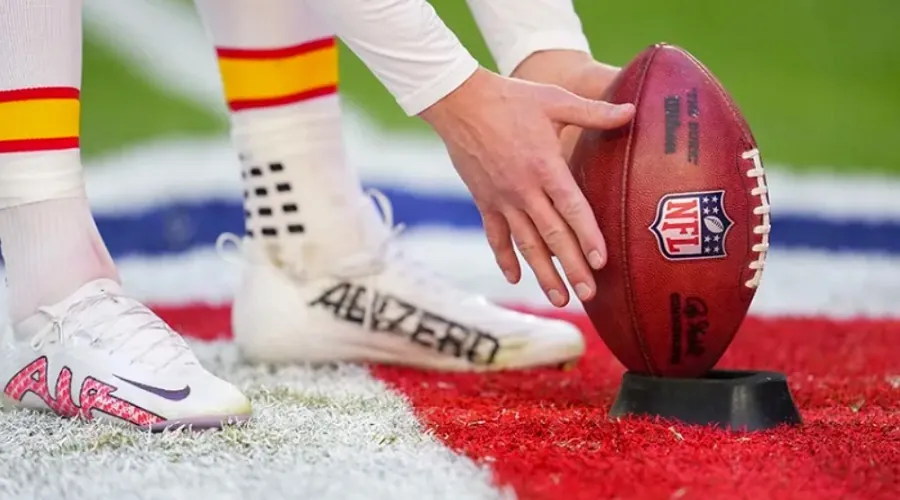
A notable example is Harrison Butker, who in the Super Bowl wore a Nike Zoom Mercurial Superfly 9 soccer cleat on his right (kicking) foot and an adidas Adizero American football cleat on his left (support) foot. Kickers often prefer soccer cleats for three reasons:
- Better Feel and Control – Soccer cleats have a thin, snug‑fitting upper that provides a superior feel of the ball, helping kickers make precise, controlled kicks for field goals and kickoffs.
- Lightweight Design – Soccer cleats are lighter, allowing a more natural kicking motion and potentially generating more leg‑swing speed for powerful kicks.
- Stud Configuration – Soccer cleats’ studs are designed for traction on natural grass, similar to many American football fields, enabling the kicker to plant securely and maintain stability.
While soccer cleats are not explicitly designed for American football, their features make them an attractive option for kickers seeking precision and a lightweight feel.
How to Choose Soccer Cleats
When selecting soccer cleats, consider these factors:
- Comfort – A snug fit without pinching or slipping is essential. Remember that cleats often stretch over time.
- Material – Leather offers a softer, more flexible feel that molds to your feet; synthetic materials provide better weather resistance and durability.
- Stud Type – For natural grass, traditional screw‑in studs are useful in wet conditions. For artificial turf, shoes with many smaller studs (turf shoes) offer better grip and comfort.
- Position – Midfielders may prefer cleats with excellent control features for passing; strikers often choose cleats that enhance shooting power and accuracy.
- Personal Style – Many designs and colors are available. Choosing cleats that make you feel confident can add enjoyment to your game.
Frequently Asked Questions
1. Are soccer cleats and football cleats interchangeable?
No. Despite some similarities, the design and functional differences make each type best suited for its respective sport.
2. Can I wear football cleats for soccer or vice versa?
Technically possible, but not recommended. The different demands of each sport can affect performance and potentially lead to injuries.
3. Are the terms “soccer” and “football” the same globally?
No. “Football” refers to soccer in the UK and many other countries, while in the US “football” refers to a completely different sport.
4. What’s the main difference between soccer and football cleats?
The main differences lie in design, material, and stud configuration, each catering to the unique demands of the respective sports.
5. Can using the wrong cleats lead to injuries?
Yes. Using the wrong cleats can cause discomfort, affect performance, and potentially increase the risk of injuries.
Related search topics
- Kicking It Right Are Soccer Cleats and Football Cleats the Same football guide
- Kicking It Right Are Soccer Cleats and Football Cleats the Same latest updates
 WhatsApp
Looking for affordable football boots and jerseys made in China?
Message us on WhatsApp at +86 151 6027 2505, or find us on Instagram at @luxurycoca.
 Instagram